DISCUSSION
Can an app know a customer better than a personal shopper?
Written by RetailWire Staff
Source: Lily
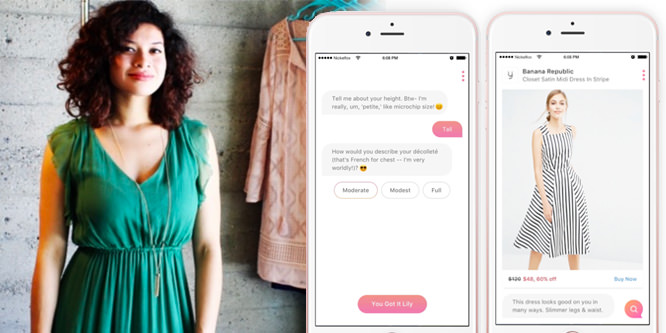
Knowing the shopper is said to be the key to sales conversion and the team behind shopping app Lily claims to have an algorithm that lets them understand fashion shoppers better. Lily purports to be able to determine the emotional connection a shopper has with her clothing through what its creators call the "Perception and Empathy Engine."
Lily, which won this year's SXSW Accelerator Pitch Event, initially built its recommendation engine based on over 10,000 interviews with women, as described in a recent Forbes article. The app asks a user questions via text about her perception of her body, then points her to clothing that it determines she will find flattering. Lily co-founder Purva Gupta told Forbes that the algorithm accomplishes this by matching "emotions, preferences and perceptions" about the customer's body with clothing from her favorite stores. Nordstrom, ModCloth and H&M are among the many popular retailers that Lily users can shop through the app.
Recommendation engines have become central to the way many online companies do business. Netflix uses the technology to push users to new content. For Amazon.com, it offers the opportunity for the site to induce an impulse buy or upsell with no sales staff required. Amazon has also been taking the principal of algorithm-based recommendations into the physical world at its bookstores where the selection is based on what books are its biggest online sellers.
In fact, some argue that being able to offer accurate recommendations may be the defining factor in the success of top companies in the coming years. A recent article in Newsweek speculates that Apple may be culled from the top five most valuable companies in the U.S. based on its inability to leverage data to better recommend products to customers the way Amazon and Google do.
While Lily uses conscious responses to attempt to build a profile of the customer's unconscious emotional desires, some retailers have been playing with technology that could add even more data points to an emotion-based recommendation engine.
Uniqlo, for instance, implemented an EEG reader that purports to read customers' brainwaves to determine their mood and match it to an appropriate t-shirt that the customer might purchase.