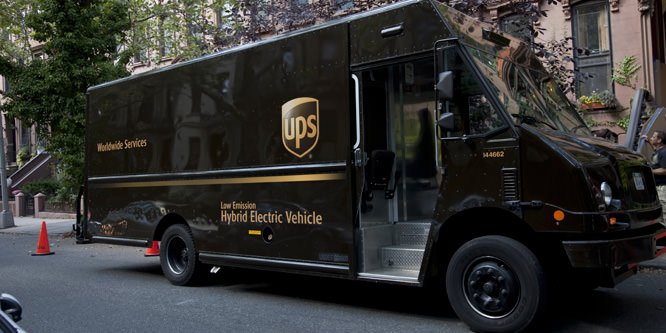
Photo: UPS
Pity the poor city apartment doorman. In the past, the job entailed screening guests, shoveling snow outside after the occasional storm and helping out with the rare delivery. With the rapid expansion of online selling, however, the front lobby now resembles a warehouse.
“With hundreds of residents now buying 10 or 20 percent of their goods online, a concierge who used to handle a flower delivery or two now may be running the equivalent of a package sort center in the building lobby,” states a press release from the University of Washington.
The release announced the university’s formation of a new lab that will bring together a multitude of stakeholders — urban planners, city officials, researchers, truck freight carriers, logistics experts, commercial developers, and companies like UPS, Nordstrom, and Costco — to study urban goods delivery and test new ideas. The lab will initially focus on the “Final 50 feet,” or the last leg between delivery drivers finding a place to park and handing off a package in a private building.
In the case of apartment and condo buildings, owners are being asked to design loading and common areas to handle the daily stream of packages. But the broader challenges involve limited curb and parking space where delivery trucks, bicycles, pedestrians and cars all need to coexist.
The project will map existing the freight infrastructures like private loading bays as well as delivery patterns. Solutions will be tested, such as managing curb space or alleys differently and exploring centralized drop-off lockers. Off-hour deliveries, for instance, may alleviate traffic and parking headaches but also drive noise complaints.
Eventually, the project hopes to develop an “Urban Freight Score” — similar to a Walk Score that rates walkability for pedestrians —to evaluate the ability of trucks to access different locations around Seattle.
“The ‘final 50 feet’ highlights the challenge of coordinating across numerous, diverse stakeholders,” said Anne Goodchild, the university’s civil and environmental engineering associate professor. “It’s a problem that isn’t going to solve itself and no one can solve independently.”
- As online retailing booms, new Urban Freight Lab to work with industry, SDOT on delivery challenges – University of Washington
- University of Washington debuts new Urban Freight Lab in partnership with Costco, Nordstrom, UPS - Geekwire
- University Of Washington, Retail Partners Like Costco, UPS Unveil The Urban Freight Lab - PYMNTS