iStock.com/mizoula | iStock.com/jetcityimage
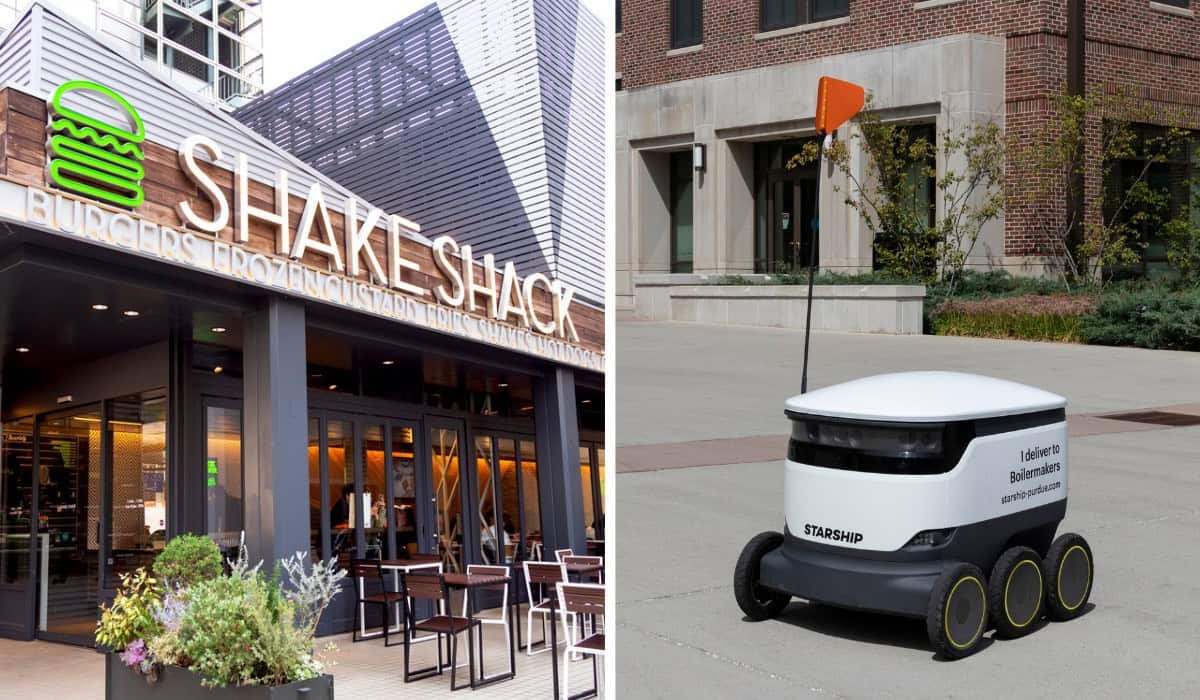
Shake Shack has partnered with Uber Eats to introduce sidewalk robot delivery for the first time to customers in Los Angeles.
Select customers ordering Shake Shack on Uber Eats will receive a notification that their delivery may be brought to them via robot. Customers can then track the robot and use the Uber Eats app to retrieve their orders when the bot arrives.
The robots are provided by Serve Robotics, which was spun off from Uber in 2021 in an initial public offering. Serve, which has also partnered with 7-Eleven, currently has 100 robots serving 300 restaurants in Los Angeles but intends to have 2,000 robots across multiple markets as part of its Uber Eats partnership by the end of 2025. In January 2022, Serve said that its robots were capable of Level 4 autonomy, which means the vehicle can operate without a human.
Co-founder and CEO Ali Kashani told CNN Business that Serve’s robots are better equipped for cities than driverless cars. He said, “It reduces congestion, it reduces emissions, it reduces accidents and fatality, and it lowers the cost to merchants.”
Steph So, SVP of digital experience at Shake Shack, told Nation's Restaurant News that earlier pilots have shown that robot delivery shortens delivery times, increases capacity, and reduces congestion of couriers in and out of the restaurant at peak times.
Food-delivery robots are more common on college campuses.
Grubhub recently partnered with robotics delivery provider Starship Technologies to bring food delivery robots to the University of South Carolina. Grub Hub told WTLX in Columbia, South Carolina, “Robots are a great fit for college campuses since those environments are notoriously difficult for cars to navigate due to one-way streets and areas on campus that don’t allow cars. Robots can get to hard-to-reach areas, which makes them a natural fit for campuses.”
Estonia-based robot delivery company Starship offers robot delivery across more than 50 U.S. college campuses, while Colombian-based competitor Kiwibot has reached over 30 campuses.
Starship said its all-electric robots reduce carbon footprint compared to gas-guzzling cars while also being cost-effective, including using less energy than human-delivery methods and offering a “no need to tip” benefit to customers. At the University of South Carolina, the fee is $3.49. Costs vary across college campuses.
Using a combination of machine learning, artificial intelligence, and sensors to navigate, the robots can cross streets, climb curbs, travel at night, and operate in rain and snow. Each robot can carry up to 20 pounds — the equivalent of about three shopping bags of goods and moves at a speed of 3.7 mph. A Starship online survey of more than 7,000 college students across more than 20 U.S. campuses found that 93% of respondents said the robots are “convenient/helpful,” with 75% seeing the robots as “friendly/cute.”
In its initial public offering filing, Serve said it expects robots to eventually work alongside drones and autonomous vehicles to support last-mile food delivery. Drones and automated vehicles are faster and can travel farther, but robots are better able to access congested areas with limited parking and are less noisy. Serve wrote, “Delivery robots, aerial drones and AVs are each efficacious for deliveries with different attributes, and all three will work collaboratively to create the most efficient automated last mile delivery network.”