Macy's Says Its 'Bold New Chapter' Plans Are Working, Expanding 'First 50' Blueprint to 125 Stores in 2025
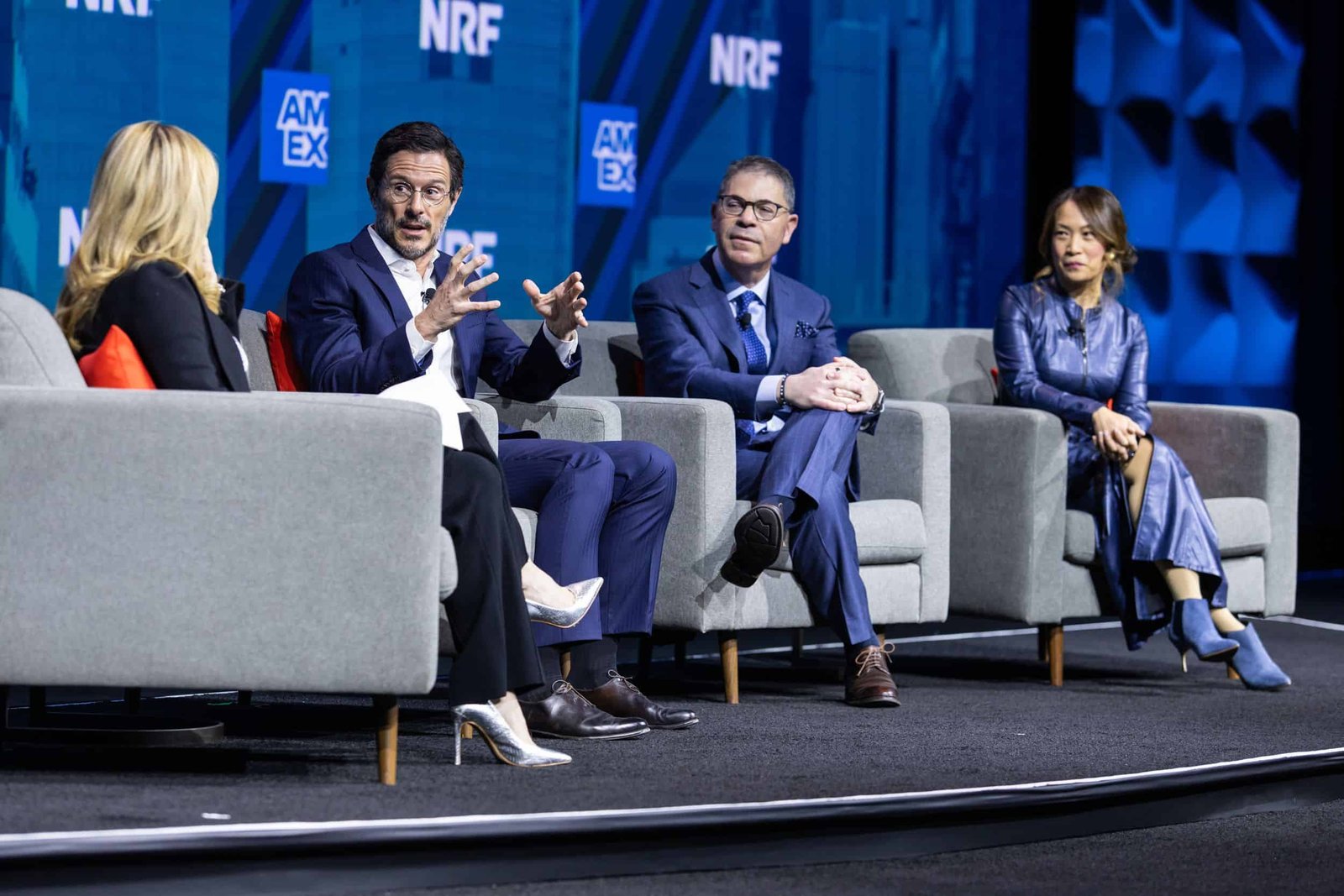
Image Courtesy of NRF Big Show 2025 - Jason Dixson Photography
At the recent 2025 NRF Big Show held in New York City, beyond the hustle and bustle of the convention floor filled with colorful booths and even more colorful personalities, a variety of panel discussions took place centered on the ever-changing nature of the retail business.
And what better example of a business in the process of fundamental change than Macy's, a brand that is currently remodeling its operations from the bottom up?
During a discussion between Tony Spring (CEO and chairman of Macy's), Olivier Bron (CEO of Bloomingdale's), and Maly Bernstein (CEO of Bluemercury), the trio covered ground ranging from the success of the company's Bold New Chapter plans to the nature of retail shopping as a therapeutic experience for many customers.
Joined by moderator Courtney Reagan, senior retail reporter for CNBC, the three executives settled in for what would be an enlightening talk about the company's successes and failures, as well as territory nearby.
Macy's Says 'Bold New Chapter' Is Paying Off
Kicking off the chat with an analysis of how the company's retooling plans (under the moniker of "A Bold New Chapter") were going, Spring suggested that he was very pleased with the direction things were currently headed.
"A Bold New Chapter was our opportunity to reimagine the Macy's portfolio, which does include Macy's, Bloomingdale's, and Bluemercury. For the Macy's brand, it's strengthening the Macy's nameplate. It was listening to 60,000 customers that we talked to who were both active and inactive," he said.
"What were they looking for in a shopping experience with Macy's? They wanted a better merchandise assortment that was both private brands and market brands. They wanted a better service experience that was additional colleagues in the store and a better visual presentation. They wanted a better modern take on marketing and a better balance in our media mix between digital and traditional marketing. They were looking for a quicker supply chain. They wanted product to be arriving faster when they ordered it. They wanted things to arrive accurately. Some of the fundamentals of retail," he added.
Moderator Reagan then prompted Spring to talk about how Macy's was addressing the demand to satisfy the aforementioned fundamentals of retail, and the CEO happily obliged, speaking of the success of the company's First 50 blueprint. Under these guidelines, starting with 50 locations in the Macy's stores portfolio, everything from merchandising to the customer experience was purposefully stepped up with a renewed intensity.
As a result, Spring noted, the First 50 project stores saw three consecutive quarters of strong growth.
Bloomingdale's Is Repositioning the Brand From 'Aspirational to Luxury'
Reagan then transitioned to ask Bloomingdale's CEO Bron how the luxury arm of Macy's is doing and what areas he believes can be improved.
"We can always do better. I think in line with the Bold New Chapter strategy for Macy’s Inc., we have our Dream Big strategy for Bloomingdale’s, and the question is how hard — and how far — we can push the boundary, where can we push the Bloomingdale’s brand forward?” Bron asked, posing the question before turning to answer.
“That’s what we’re working on right now. I think we can do a little bit more in terms of customer experience and brand experience. We can do better. We can keep improving the service in the stores. This is what we're doing, and we have to push the repositioning of the brand from aspirational to luxury," he concluded.
Spring Rejects Notion of the Department Store as Tired or Outdated
As Reagan pivoted back to Spring, she posed the question as to whether a savvy modern consumer might perceive the department store as a tired format.
"Why do I need a department store anymore? I know the brands, I can go right to those brands online. So why does somebody need to come to Macy’s?" Reagan asked as a hypothetical.
Spring was quick to respond, emphasizing the dynamic nature of his ideal experience concerning such a potential challenge.
"I think the department store format, if you like the name marketplace better, maybe that helps people to kind of reimagine the potential of a marketplace or a department store. If I told you we could be in any business we want to be, you’d say that's a pretty exciting piece of opportunity. You're not limited to just men's, or to women's, or to kids, or to home. If I said we could do it in either channel, physical or digital. If I said we could basically expand any business, or contract any business, based on the opportunity that we saw that season. So, if men's is a little softer, and women's is doing well, we can fund into those things with more people, more advertising, more inventory," he explained.
"I think the key to remember is that the department store, essentially, is the curation of choice. We all love choice, right? I don't want you to tell me what I have to have, but please don't give me that endless aisle that goes on forever. I want the best style. I want the number of choices that I, as a consumer, think are appropriate — and I want them fast. I think the department store is well positioned to be able to offer that, and the three of us together — looking at Bloomingdale's, and Macy's, and then the specialty niche of Bluemercury — I think gives the consumer so many options, but done in a way that makes it easier to shop," Spring concluded.
Bluemercury's Store Success Is About Customization, Fun, and an 'Uncover to Discover' Ethos
Bluemercury CEO Bernstein highlighted the role of a highly personalized and customized customer experience as being central to the brand's success, particularly at the store level.
When asked by Reagan as to how the brand was looking to expand and broaden its demographic base, Bernstein gestured toward a dedication from frontline workers to employ empathy and inquisitiveness to really reach each customer on an individual level, assessing needs and desires and responding with appropriate solutions.
"At Bluemercury, what's so fun is that we customize the beauty plan for you, and what we do is we ask you a whole bunch of questions. Which we call ‘uncover to discover’ what is it that you need," Bernstein began.
"So whether you're a man, whether you're younger, whether you're older, we really focus on understanding you, your needs, your aspirations, and then we curate using our assortment that's so driven on performance, so driven on making sure that you get the results that you're looking for. That's how we do it, we tailor it for every customer that walks through our door," she added.
Spring, Bron, and Bernstein Speak to the Current Mood of the American Consumer
In closing, Reagan asked all three execs what they thought the current mood of the American consumer might be.
Bernstein summed up her response in one word, "hopeful," and Bron followed suit with "dreaming," before expanding further. "They want to dream, they want to be excited... They want something special," he added.
Spring gave a balanced answer that evoked the duality of moods common to the U.S. consumer.
"Excited, you know, I think they're nervous, but they're excited because they're sitting on the cusp of one of the most interesting times in their lives, where technology is meeting humanity, where opportunities kind of come along," he said. "And at the same time, you see the downside of what happens when the dark web is more pervasive in people's lives. So it's just… how do we have the protections [in place] so that people can truly enjoy this extraordinary moment in time?"
What's Next for Macy's?
Other topics of conversation included the question of whether Macy's was considering the spin-off or sale of Bloomingdale's or Bluemercury. Spring indicated that this was not his desired path forward, as the brands offered "synergies that are leveraged between the three brands, between warehousing, legal, finance, back-end operations, joint brand negotiation. There's just so much opportunity for us to kind of leverage the scale of the portfolio."
He added, "The key is for the customer to find something special, something different at Macy's, Bloomingdale’s, and Bluemercury, and at the same time for us to continue to try to make the case to the public markets that this three-brand portfolio has more value than we are showing today.”
Macy's CEO also spoke about the centrality of taking care of the customer to ensure the company's continued success.
“Remember, we're in the retail therapy business, essentially we have folks that want to come in and escape their everyday life in some way, shape, or form… We are there to try to create the kind of retail experience I think that people truly enjoy, and that's why I was never a believer coming out of the pandemic that it was going to be a digital-only business. It was going to be a digital and physical business where the two actually talk to one another and give the choice back to the consumer about what is best for you," Spring said.
Success could be in the cards for Macy's, at least concerning its aforementioned focus areas.
According to a recent press release, Macy's First 50 stores, Bloomingdale's, and Bluemercury all reported positive comparable sales in its latest Q4 update. Meanwhile, sales remained relatively flat for non-First 50 stores, as well for the company's non-go-forward locations.
"Our Bold New Chapter strategy continues to gain traction, putting us on track to achieve our second quarter of sequential comparable sales improvement," Spring stated in comments attached to the report. "Reflecting ongoing positive response to Macy’s First 50 locations, we are excited to expand initiatives to an additional 75 Macy’s locations in Fiscal 2025. We are well-positioned to build momentum with a stronger Macy’s store fleet and our teams focused on the successful execution of the three pillars of our Bold New Chapter strategy."
Overall, Q4 sales are expected to rest between $7.8 to $8 billion, roughly in line or slightly below the low end of previously issued projections.
"We said 2024 was a transition and investment year, and I look as we're getting ready to close the year and close the quarter, I'm pleased with the progress that we're making," Spring stated during the NRF session. "We're also mindful of the fact that we've learned a lot along the way and we'll go into 2025 more informed, more educated, better prepared to return Macy's Inc. to sustainable, profitable growth."