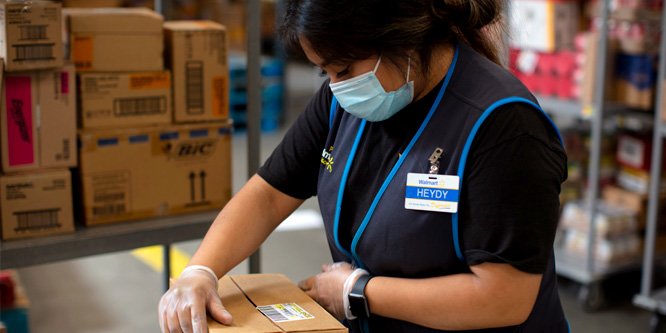
Photo: Walmart
Knowledge@Wharton staff
Presented here for discussion is a summary of a current article published with permission from Knowledge@Wharton, the online research and business analysis journal of the Wharton School of the University of Pennsylvania.
American consumers are crowding back into stores and restaurants as states ease pandemic-related restrictions. But a full return to normal isn’t likely to happen until November 2021, according to Zeke Emanuel, chair of the Department of Medical Ethics and Health Policy at the University of Pennsylvania and a Wharton professor.
“That’s your date,” Prof. Emanuel said at a video conference in late June hosted by Wharton’s Jay H. Baker Retailing Center. “I’m generally a very optimistic guy, and I’m being realistic here.”
Mr. Emanuel believes that’s how long it will take for an effective vaccine to be distributed widely enough to stop COVID-19’s spread.
Until then, corporate employees should continue to work from home as much as possible, because enclosed spaces and prolonged exposure to others increases the likelihood of transmission. Mandatory masks, plexiglass dividers and regular sanitizing of hands and surfaces should be standard protocol to protect frontline workers who cannot work remotely, including store employees.
He said stores have much to consider. Can some merchandise be put outside to limit the number of shoppers inside? Can windows or doors be opened to help circulation?
For employees, use of face masks will remain important, although he suspects daily symptom screening questions will be more effective than temperature checks.
Testing more than once a week for asymptomatic employees is wasteful and can create a false sense of security, he said. Instead, an emphasis on personal hygiene — especially washing hands — and store cleaning is reassuring for both employees and customers.
Store closures depend on a lot of factors, including the concentration of local cases, evidence of transmission among workers, store design, etc.
An advocate for a safe reopening of the economy, Prof. Emanuel believes strict adherence to non-pharmacological interventions — i.e., social distancing, wearing masks, avoiding crowds and enclosed spaces — work better than haphazard compliance with them.
“I think it’s almost inevitable we’re going to have a second wave that pops up in October or November [of this year], when we’re all going inside. That worries me a lot,” he said. “Adhering to strict measures doesn’t seem possible in the U.S.”
- A Return to ‘Normal’: How Long Will the Pandemic Last? - Knowledge@Wharton