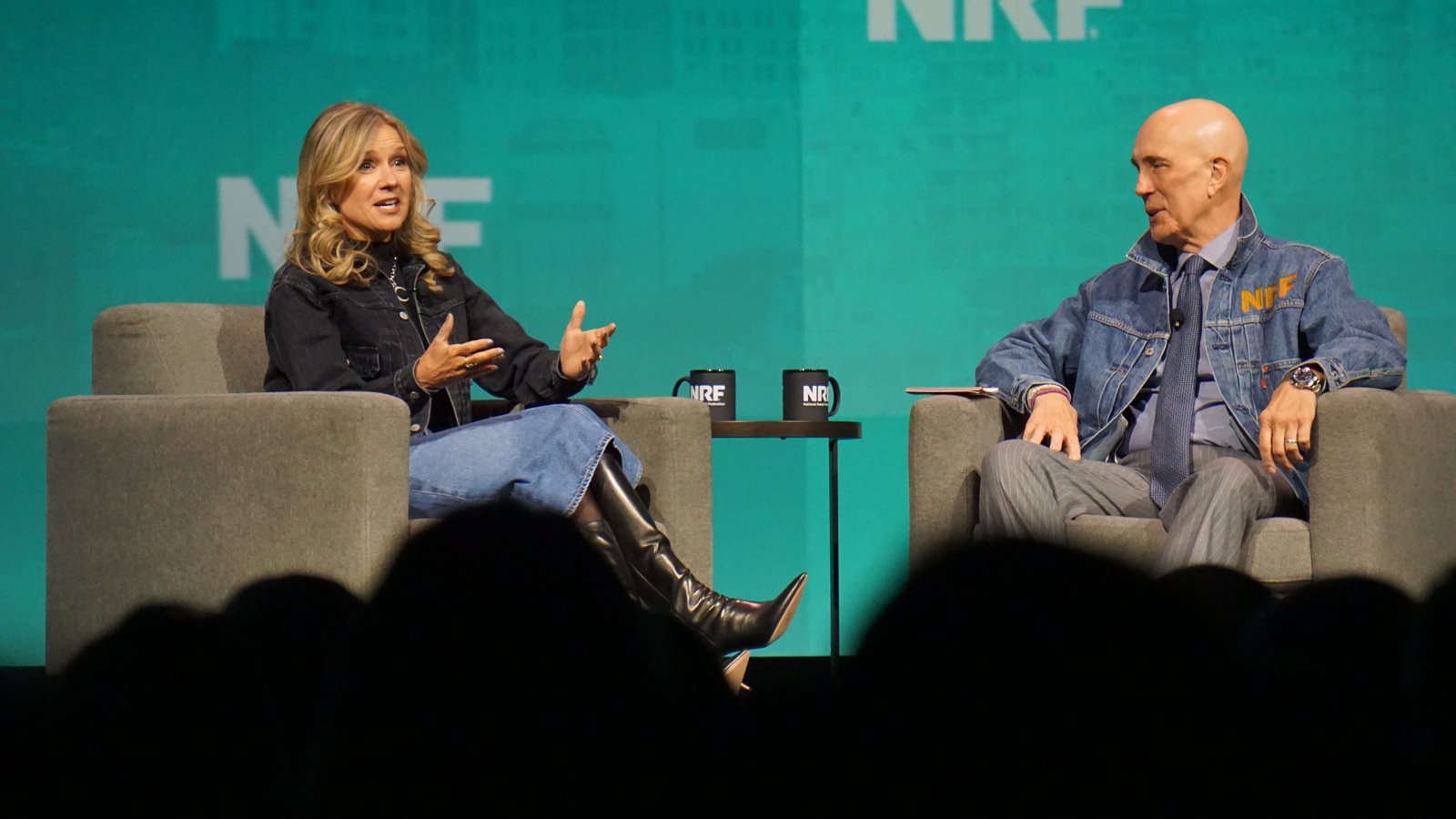
Photo: Jamie Tenser
Speaking Sunday at NRF 2024: Retail's Big Show, Michelle Gass, Levi Strauss & Co.’s incoming CEO, highlighted five key learnings over her 33-year retail career ranging from the power of brands to the culture that’s prepared her to guide the iconic denim brand’s next stage of growth.
After beginning her career at Procter & Gamble (P&G), Gass worked for nearly 17 years at Starbucks, ending as president, EMEA. In 2013, she joined Kohl’s as chief merchant and customer officer and was promoted to CEO in 2018. In January 2023, she became Levi’s president, and she will replace Chip Bergh, the brand’s long-time CEO, as part of a succession plan on Jan. 29.
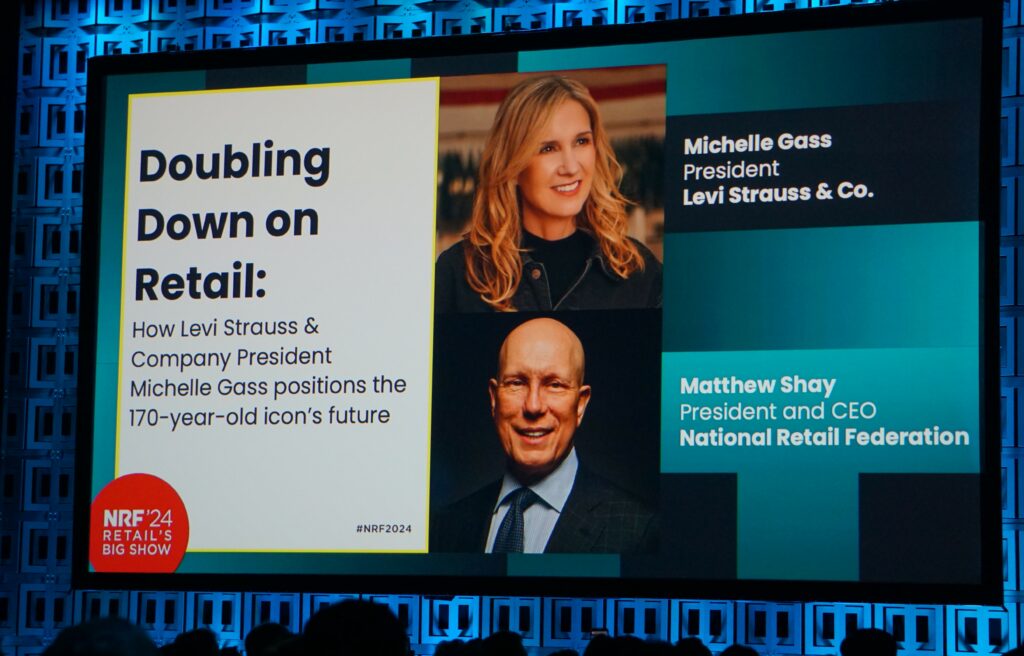
In her interview with NRF’s president and CEO Matthew Shay, the five key learnings she listed over her career included:
- Power of brands: Gass said, “I grew up from Procter & Gamble, the place where you learn to never forget a brand is one of your most important assets. And if you don't have a strong brand, like the rest of it, it's gonna be really, really tough.”
- Consumer obsession: She said, “You always have to be obsessed about the consumer. The consumer is the center of everything. I know a lot of companies say that — you’ve got to really mean it.”
- Power of innovation: Gass highlighted the benefits of outside-the-box ideas, including Kohl’s decision to accept in-store returns of Amazon merchandise, which was questioned at the time but has paid off in traffic gains for Kohl’s and is a customer experience win for Amazon. In her time at Starbucks, she cited the breakout success of the Pumpkin Spice Latte, which didn’t test well with focus groups or flavor tests but recently celebrated its 20th anniversary. She said, “Innovation is like looking around corners, thinking about things consumers don't know they need.”
- Omnichannel retail: Gass believes “everybody today needs to think like an omnichannel retailer,” whether retailer, food establishment, or brand. The opportunity to build an omnichannel approach is what attracted her to Kohl’s in 2013. She said, “The industry was going through so much disruption. Kohl's was operating as a brick-and-mortar retailer. We had to rewire the company on top of all the innovation of course, but rewire the company to really operate as a best-in-class omnichannel retailer, and the e-com business started with less than $1 billion and is now $6 billion.”
- Purpose and values: Gass believes every company she’s worked for has been a “purpose-driven company,” including Levi’s. Gass said, “I love the phrase at Levi's, ‘We talk about everything we do.’ It’s driving profits through principles, and they live it.”
In assuming leadership of Levi’s, Gass cited the opportunity to further “rewire the business to truly operate as a retailer in being more agile, being faster — having that metabolically like retail does, which is exhilarating.”
She noted that wholesale “continues to be really important,” but retail has grown to 40% of Levi’s sales. Geographically, retail is seen as a primary growth driver in the U.S. Internationally, growth in China, India, and other parts of Asia are “just getting started,” she said.
By categories, she sees Levi’s still having a rich opportunity to extend beyond bottoms for “more head to toe” dressing, from denim skirts and dresses to tops across fabrications for the “perfect pairing to your pair of blue jeans.”
Gass enthused that Levi’s has an “incredibly strong foundation” given the brand’s 170-year legacy and the progress made over the last decade by Bergh in “really putting Levi's back into the center of culture and connecting it to everything that's relevant socially today,” whether music or social issues.
She said, “It’s Levi’s. It’s the 501. That’s not going to change. It’s a beloved, iconic brand around the world. What an amazing opportunity to come here with all of this brand strength. But yes, we have to continue to invest.”