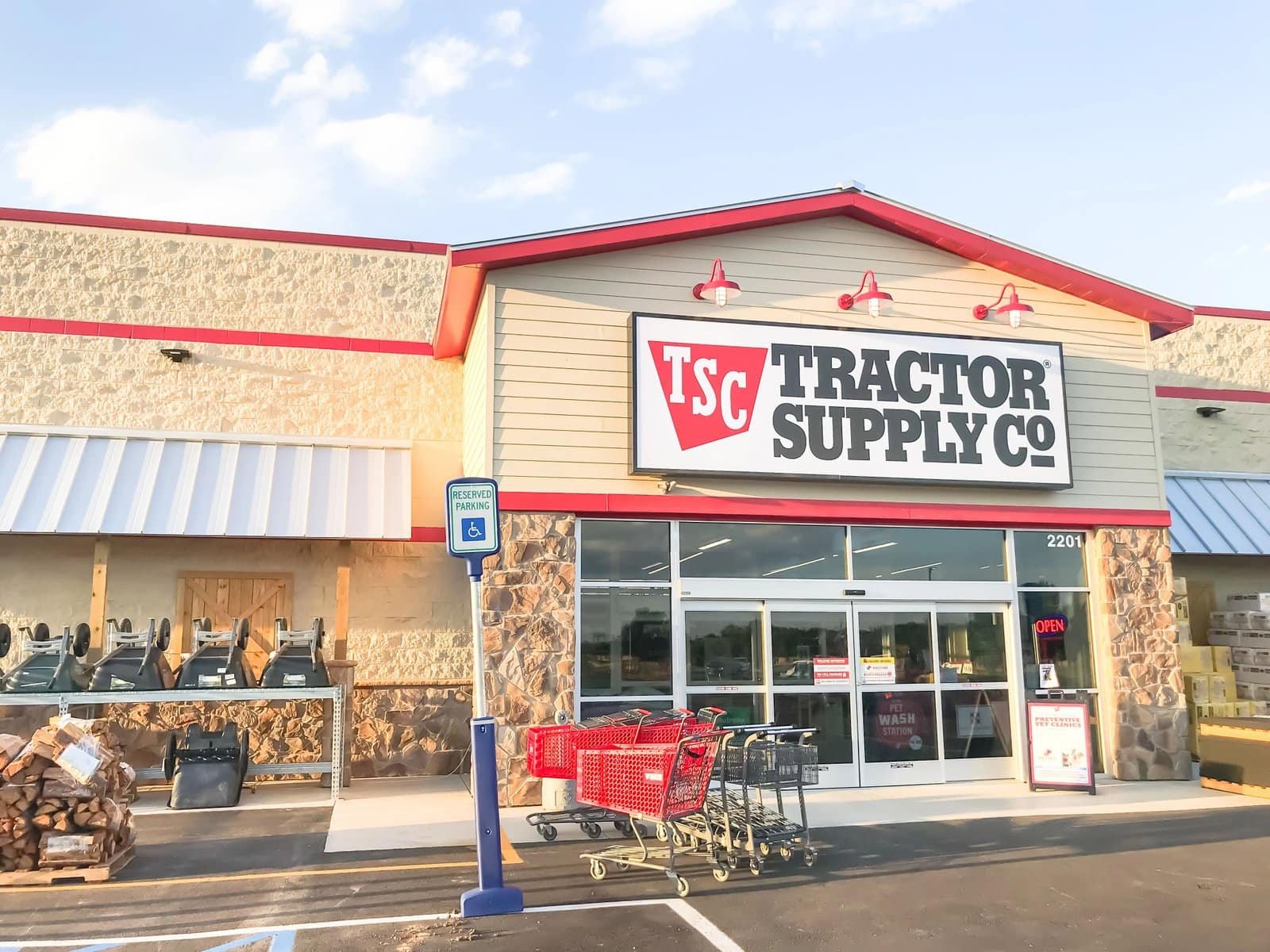
Tractor Supply OpenAI

December 4, 2025

trongnguyen/Depositphotos.com

Will Tractor Supply’s All-In Gamble on OpenAI Pay Off?

Given the proliferation of maturing artificial intelligence (AI) models, from OpenAI’s ChatGPT to Google’s Gemini (and Nano Banana) as well as Microsoft Copilot, Anthropic, or Perplexity, it seems there is an almost endless degree of choice — both for consumers considering buying in, and for companies looking to leverage these new tools to gain advantage.

That appears to be a choice that Tractor Supply has committed to, according to a report issued by Modern Retail’s Mitchell Parton. While Tractor Supply had been testing the waters surrounding a number of players in the AI space, it has elected to solely partner with one prominent entity — OpenAI — since earlier this year.

“In early 2025, the company made a decision to build a stronger collaboration with a single AI vendor — OpenAI — rather than using several different platforms. The only exception where the company will use AI technology from others will be in instances where it is embedded in another piece of software, such as software used for replenishment,” Parton outlined.

In the interim, OpenAI tech has been deployed to create the AI assistant found on Tractor Supply’s website, in addition to assisting with the retailer’s complex supply chain operations. Rob Mills, EVP and chief technology, digital and corporate strategy officer for Tractor Supply, noted that it was his inclination to collaborate with OpenAI on the best possible use cases for his company, drawing out a forward-looking game plan that would center consistency and innovation in the years to come.

“You can tell [OpenAI is] hungry to learn about how companies and retailers, specifically, are using this technology,” Mills said, as quoted by Parton.

“OpenAI is here at a different level of collaborating with us [than other vendors] and giving us great insights into the things they’re working on, so we can be ready to take full advantage of it, [and] they’re leaning in on us to learn to make their tool more successful, or just better,” he added.

Among the other aspects of the OpenAI tech parcel that Tractor Supply is implementing, based on an ongoing dialogue between the two parties, per Mills:

  • A “computer vision” tool which analyzes both customer and associate behavior, able to notify employees when a number of customers are in checkout lines or other use cases.
  • A consultation feature between AI and staff members, with the goal being that Tractor Supply workers can bounce ideas for responses to customer questions off an internal chatbot.
  • A training program launched by the retailer hinging around the concept of prompt engineering, particularly within the realm of relevance pertaining to Tractor Supply’s daily operations — front line or otherwise. “If you don’t write those workflows appropriately or have strong prompts, you could potentially get just bad data. We’re doubling down and really putting a lot of energy around that,” Mills said.

Tractor Supply Bets Big on OpenAI — But Competitors Are Toiling Away, Too

One potential issue with such a big bet being made by Tractor Supply on a sole AI collaborator — in this case, OpenAI — is that it leaves competitors free to innovate, potentially creating first-to-market capabilities that the retailer won’t be able to leverage.

Jason Goldberg, chief commerce strategy officer at Publicis, was cited by Parton on this score, with Goldberg making it plain that these big bets on single players in the AI space were inappropriate given the nascent nature of the current state of affairs.

“Here’s the problem with all of these LLMs — the best one changes every week. At any given time, one is better for image generation than the other, and one is better for deep-thinking research, and one is better for writing; and whichever one I say is better, that’s all going to be different in two weeks,” Goldberg began.

“A smart business, and a smart retailer in particular, probably wants access to all of those tools, and they want their employees using the right tool in the right moment. So, these kinds of exclusive all-in things are more of a disadvantage than they’ve ever been before,” he concluded.

BrainTrust

"Will the decision by Tractor Supply to work with a single AI vendor end up being beneficial, or a hindrance, in your opinion?"
Avatar of Nicholas Morine

Nicholas Morine


Recent Discussions

Discussion Questions

Will the decision by Tractor Supply to work with a single AI vendor end up being beneficial, or a hindrance, in your opinion?

What pros / cons more broadly do you see for retailers signing on with a sole AI tech supplier? Is it wiser to broaden your toolset, or does this risk incompatibility or lack of cohesion?

Do you see OpenAI / ChatGPT taking an early lead in the retail AI space? Which competitors can lay claim to being significant threats, in your view?

Poll

2 Comments
Oldest
Newest Most Voted
Inline Feedbacks
View all comments
Scott Benedict
Scott Benedict

I believe Tractor Supply’s decision to rely on a single AI vendor — OpenAI — is a bold yet justified move, especially considering its farm-and-home retail model and the need for consistency across a large, dispersed store network. By consolidating on one platform, TSC simplifies management, guarantees uniformity of tools (for inventory, customer service, product knowledge), and accelerates AI deployment across its locations — which can be a major advantage in a niche retail market that requires extensive product expertise and accurate inventory. What’s notable is that TSC has already integrated AI into daily store operations (such as in-store assistants, inventory tools, employee support) instead of viewing AI as a mere flashy addition. This practical approach boosts the chances that their AI investment will succeed. 

However, committing to a single vendor involves clear risks. The world of generative AI is changing quickly — strengths move from one model to another, new capabilities develop, and no single provider excels at everything. Relying on only one supplier can cause vendor lock-in, decrease flexibility, and leave a retailer vulnerable if that vendor falters or fails to innovate in certain areas (e.g., computer vision, long-context reasoning, multimodal tasks). For farm-and-home retail, where product categories are broad and sometimes highly technical (e.g., pet, lawn & garden, tools, horse/farm supplies), having the ability to access specialized AI functions can be crucial. Using multiple vendors or models can help match the best AI tool to each task, although it adds complexity.

Looking at the bigger landscape: yes — OpenAI / ChatGPT has an early lead in retail AI deployments (especially in conversational assistants, knowledge database support, and store associate tools) because of its maturity, developer ecosystem, and scalability. That said, competitors — whether from established cloud providers or emerging AI-specialist firms — pose real threats, especially as new models develop strengths in niche areas like image-based merchandising, real-time demand forecasting, and supply chain optimization. The risk for Tractor Supply — and any retailer — is that the AI model best today may not be best tomorrow.

For Tractor Supply’s segment and shopper base—rural, practical, value-oriented, often making repeat purchases or seeking “how-to” information—I see significant potential in carefully implemented AI: quicker responses from store associates, more accurate inventory tracking, better supply chain visibility, and more helpful customer service. The key, however, will be discipline: managing data governance, continuously assessing vendor performance, being prepared to adopt new models if necessary, and ensuring AI tools address real operational challenges rather than just theoretical benefits. In that regard, their choice to rely on a single vendor can work— but only if it is viewed as a strategic foundation rather than a permanent lock-in.

Neil Saunders

There are so many AI models out there and navigating and integrating all of them, or even many of them, into the business is very time consuming. However, we are at such an early stage with AI and different models have different strengths, so placing a bet on one seems somewhat premature. Somewhere within the retail business, there needs to be experimentation and testing to ensure that retailers are keeping pace with the newest and best AI technology.

2 Comments
Oldest
Newest Most Voted
Inline Feedbacks
View all comments
Scott Benedict
Scott Benedict

I believe Tractor Supply’s decision to rely on a single AI vendor — OpenAI — is a bold yet justified move, especially considering its farm-and-home retail model and the need for consistency across a large, dispersed store network. By consolidating on one platform, TSC simplifies management, guarantees uniformity of tools (for inventory, customer service, product knowledge), and accelerates AI deployment across its locations — which can be a major advantage in a niche retail market that requires extensive product expertise and accurate inventory. What’s notable is that TSC has already integrated AI into daily store operations (such as in-store assistants, inventory tools, employee support) instead of viewing AI as a mere flashy addition. This practical approach boosts the chances that their AI investment will succeed. 

However, committing to a single vendor involves clear risks. The world of generative AI is changing quickly — strengths move from one model to another, new capabilities develop, and no single provider excels at everything. Relying on only one supplier can cause vendor lock-in, decrease flexibility, and leave a retailer vulnerable if that vendor falters or fails to innovate in certain areas (e.g., computer vision, long-context reasoning, multimodal tasks). For farm-and-home retail, where product categories are broad and sometimes highly technical (e.g., pet, lawn & garden, tools, horse/farm supplies), having the ability to access specialized AI functions can be crucial. Using multiple vendors or models can help match the best AI tool to each task, although it adds complexity.

Looking at the bigger landscape: yes — OpenAI / ChatGPT has an early lead in retail AI deployments (especially in conversational assistants, knowledge database support, and store associate tools) because of its maturity, developer ecosystem, and scalability. That said, competitors — whether from established cloud providers or emerging AI-specialist firms — pose real threats, especially as new models develop strengths in niche areas like image-based merchandising, real-time demand forecasting, and supply chain optimization. The risk for Tractor Supply — and any retailer — is that the AI model best today may not be best tomorrow.

For Tractor Supply’s segment and shopper base—rural, practical, value-oriented, often making repeat purchases or seeking “how-to” information—I see significant potential in carefully implemented AI: quicker responses from store associates, more accurate inventory tracking, better supply chain visibility, and more helpful customer service. The key, however, will be discipline: managing data governance, continuously assessing vendor performance, being prepared to adopt new models if necessary, and ensuring AI tools address real operational challenges rather than just theoretical benefits. In that regard, their choice to rely on a single vendor can work— but only if it is viewed as a strategic foundation rather than a permanent lock-in.

Neil Saunders

There are so many AI models out there and navigating and integrating all of them, or even many of them, into the business is very time consuming. However, we are at such an early stage with AI and different models have different strengths, so placing a bet on one seems somewhat premature. Somewhere within the retail business, there needs to be experimentation and testing to ensure that retailers are keeping pace with the newest and best AI technology.

More Discussions