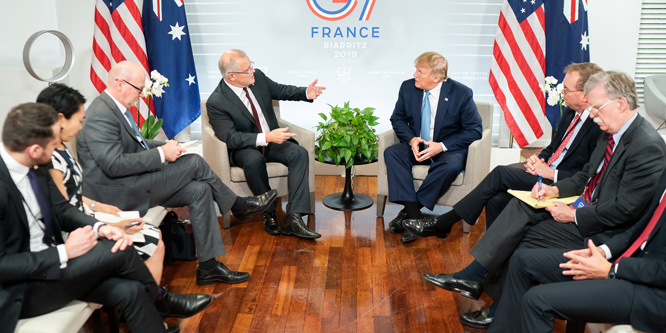
President Trump with Australian Prime Minister Scott Morrison at the 2019 G7 Summit - Photo: The White House
The trade war got uglier Friday as President Donald Trump threatened to raise tariffs higher and ordered U.S. companies to exit China after Beijing unveiled retaliatory tariffs on $75 billion in U.S. goods.
Mr. Trump called for existing U.S. tariffs on $250 billion worth of goods to be hiked to 30 percent from 25 percent. He also said he would raise planned tariffs on another $300 billion worth of goods to 15 percent, up from an earlier plan of 10 percent levies beginning Sept. 1.
Finally, Mr. Trump threatened to declare a dubious “national emergency” to order U.S. companies to cut ties with China.
The developments rocked the stock market and heightened concerns that the continuing trade war could drive the U.S. into a recession. Earlier today, as reported by Reuters, President Trump, said Chinese officials had contacted his administration and expressed a desire to return to the bargaining table. However, with the on-again, off-again dynamics at play, the retail industry continues to deal with uncertainty.
In reporting second-quarter results in recent weeks, a number of U.S. companies, including several retailers, have already pared profit and sales expectations for the year due to tariff fallout.
Macy’s said it was forced to raise prices on some luggage, housewares and furniture to offset the costs of a 25 percent tariff implemented in May on those types of goods. Jeff Gennette, Macy’s CEO, told analysts, “We know from the earlier tranche of tariffs though that today’s customer doesn’t have much appetite for price increases.”
Beyond the expense and time spent finding alternative sourcing, bringing in goods earlier to avoid tariff deadlines and re-negotiating prices, the uncertainty is leading companies to postpone or cancel projects.
In a white paper released last Thursday, Tim Anderson, SVP of Hilco Valuation Services, said multiple retailers had either delayed anticipated product/line launches or cut production altogether. He wrote, “This is especially true where companies have determined that revised price points after the new tariffs would have well exceeded what their research told them was the maximum pricing tolerance level for a new product.”
Not unsurprisingly, Friday’s escalation led to strong criticism from the National Retail Federation, American Apparel & Footwear Association, Retail Industry Leaders Association, Consumer Technology Association and other retail trade groups. Said NRF’s SVP for government relations David French, "It's impossible for businesses to plan for the future in this type of environment.”
- Macy's, Inc.'s (M) CEO Jeff Gennette on Q2 2019 Results - Earnings Call Transcript – Seeking Alpha
- Walmart's earnings beat allays worry over tariff impact for now – Reuters
- Hilco Global Report on Retail Reinforces Concerns About Fourth Quarter Sales Slowdown in Wake of China Tariff Concerns – Hilco/PRNewswire
- Rising tariffs spark spending concerns – The Associated Press/Arkansas Online
- Escalation: ‘Where Does This End?’ – National Retail Federation
- Retailers Face Tough Decisions as China Tariff Pressures Mount – Hilco
- Raising Tariffs Hurts Americans, Not China – Consumer Technology Association
- RILA: End This Trade War Before The Damage Is Irreversible – Retail Industry Leaders Association
- AAFA Condemns Administration’s No-Strategy Tariff Policy – American Apparel & Footwear Association
-
Trump says China trade deal coming, Beijing calls for resolution – Reuters