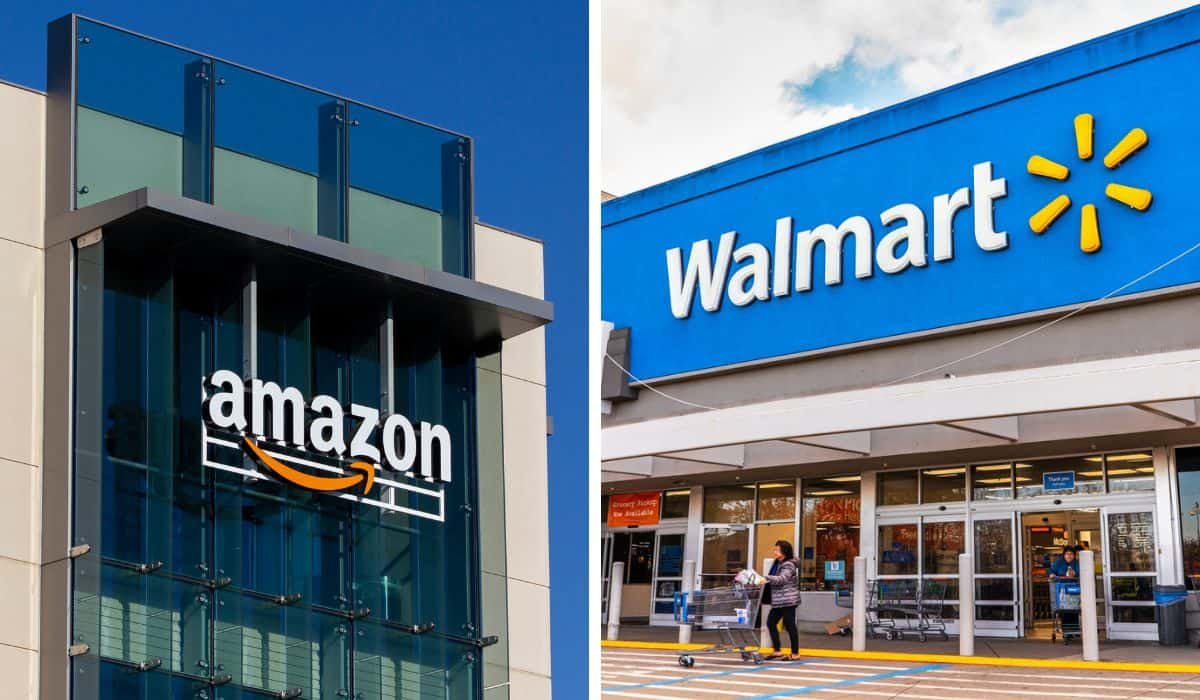
Walmart's 'And' vs. Amazon's 'Why': Which Retailer's Philosophy Is Better for Business in 2025?
In a May 27 observational piece written by Retail TouchPoints editor Nicole Silberstein, two competing philosophies — each concisely condensed into a three-letter word — were set against each other for comparison and contrast.
The two companies in question? Walmart and Amazon, a pair of the largest retailers on Earth. Their respective philosophies, Walmart’s focus on “and” and Amazon’s emphasis on “why,” were highlighted, inviting deeper examination and evaluation of their effectiveness.
Walmart as an 'And' Company, Blending Perceived Counterbalancing Forces
Silberstein first quoted Walmart CEO Doug McMillon in remarks he'd made in an April 9 update concerning the company's financial future.
“We’re an ‘and’ company: People and tech. Stores and eCommerce. Innovation and execution," McMillon said, seemingly underscoring Walmart's goal of blending disparate elements of each facet of its operations to achieve not only balance, but a foothold to serve each individual customer's or client's needs.
The Retail TouchPoints editor then provided a quick debrief on Walmart's history, from its 1962 founding to quickly becoming the default "everything store" years in advance of Amazon's adoption of the moniker. And as Silberstein pointed out, Walmart almost certainly influenced Amazon’s early focus on becoming a low-price leader — and on building a reputation around that identity. However, Walmart seems to have pivoted slightly to allow Amazon and other retailers to take the lead on certain business fronts, then adopting what proves successful.
"More recently, though, Walmart has shifted somewhat out of the realm of first mover when it comes to new innovations, making its current strategy seem a bit more along the lines of 'business as usual AND whatever Amazon is doing,'" Silberstein opined, bringing the "and" back into focus.
In her analysis, Silberstein characterized Walmart’s “and” philosophy as a strategic willingness to let Amazon test "wild ideas" — often at some significant expense — and then jumping on "only the opportunities that prove to be successful," adding these tactics to its own arsenal. Playing conservatively at the high-rollers' retailer table seems to be working for Walmart, she noted, with the blue-and-yellow brand also holding a distinct advantage over Amazon in terms of its brick-and-mortar presence — an arena wherein Amazon has struggled to gain a meaningful foothold.
Amazon's 'Why' Question: Fundamental to Its Continued Growth
Discussing Amazon, Silberstein cited CEO Andy Jassy's April 10 letter to shareholders.
“Amazon is a ‘why’ company. We ask why, and why not, constantly. It helps us deconstruct problems, get to root causes, understand blockers, and unlock doors that might have previously seemed impenetrable. Amazon has an unusually high quotient of this WhyQ (let’s call it 'YQ'), and it frames the way we think about everything that we do," Jassy wrote at the time.
The "why" questions were numerous, beginning with "Why can't we offer customers every in-print book?" and evolving from there to include more daring questions such as "Why should we be the only sellers of items in the Amazon store?" — opening the door to marketplace platforms, such as Walmart's own — and "Why not experiment with relevant advertisements in our store to expose customers to new sellers and items?" — earmarked as a cornerstone of today's vibrant and growing retail media network landscape.
With other "why" questions leading to the creation of Amazon Web Services and Prime Video, Silberstein pointed out the boldness with which Amazon embraced diving into avenues outside of the established framework of a traditional retailer.
"Indeed, Amazon’s solutions to these questions have often resulted in unexpected answers that at first seemed counterintuitive: A retailer letting other companies sell from its store? A retailer offering a streaming content service? A retailer selling its technology to other retailers? A retailer offering its industry-leading delivery service to other merchants?" she began, before quoting Jassy once more on the essential nature of risk-taking and experimentation for the company.
“Every one of these ‘Whys’ have led to significant invention, and every one of them have made customers’ lives better and easier. Some of these seem obvious now, but at the time these were provocative questions that required curiosity, risk-taking, experimentation and persistence to make these into success stories," Jassy concluded.
With Silberstein pointing out that Amazon exhibited no sign of backing down from its experimental methodology, it appears that both companies — Walmart with its focus on reinforcing fundamentals while moving heavily onto proven ground, and Amazon constantly testing its capabilities in new or emerging technologies and potential markets — have established successful, if vastly different, business philosophies.
Discussion Thread0
The RetailWire Daily
One morning briefing: the retail news, expert perspective, and business context to bring into your next meeting.
Want to know more? Learn more