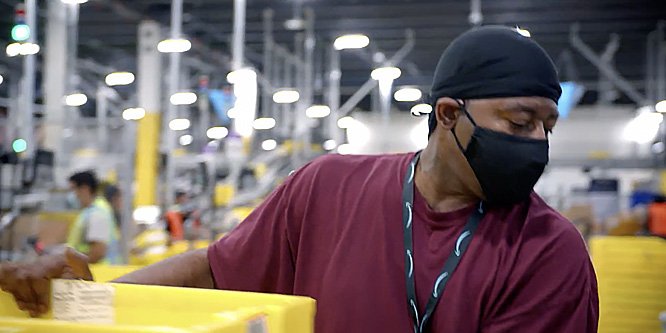
Source: Amazon video
Employees at an Amazon.com warehouse in Bessemer, AL, will begin receiving ballots next week from the National Labor Relations board to vote on whether or not to be represented by the Retail, Wholesale and Department Store Union. The New York Times reported last month that more than 2,000 workers at the facility signed cards calling for the vote.
Amazon, which pays a starting wage of $15.30 an hour in a state with no minimum wage, also offers a dental, medical and vision insurance as well as a retirement plan and other benefits. The company contends that the 5,800+ workers at the warehouse do not need to be represented by any union. Voting for one, it contends, would essentially take money out of workers’ pockets in the form of dues, according to a Washington Post report.
On paper, it appears as though Amazon has made a strong case for itself. What management may be missing here is that employees complain that their job performance evaluations are based on unrealistic company-set goals. Some complain that they do not have time to take needed bathroom breaks.
The Post reported that the RWDSU’s organizing efforts have not been built on wage or benefit pitches alone. The union has focused on workers’ perception of unrealistic performance demands while advocating that collective representation can create the conditions for a workplace notable for the “respect and dignity” given to employees.
RWDSU president Stuart Applebaum told the paper, “We see this as much as a civil rights struggle as a labor struggle.”
Nelson Lichtenstein, a labor historian at the University of California, Santa Barbara, told the Times that a vote to unionize in Alabama “would have a huge ripple effect” that could extend to other Amazon facilities and other non-unionized companies.
Even if the Bessemer workers vote to unionize, there’s no guarantee of short-term improvements with many expecting that it will take years for Amazon and the RWDSU to negotiate a labor deal.
Another extenuating circumstance in this particular case is that the warehouse is located in a “right to work” state, which means that, even if a majority vote to be represented, workers will still have the option of not joining the union. The Wall Street Journal reports that some workers it interviewed said they would likely not join the union, even if their coworkers choose to do so.