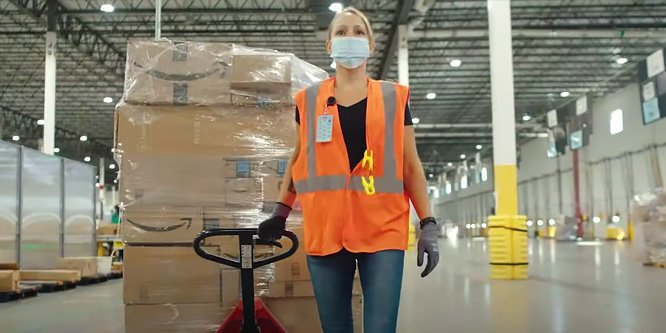
Source: Amazon recruitment video
The retail industry has a labor problem. Companies are looking for more workers to fill positions in stores, warehouses and field and corporate offices while in many cases simultaneously dealing with an exodus of employees looking for better opportunities.
Record numbers of workers have been quitting their retail jobs in recent months, in some cases going to other retailers that pay higher wages — Amazon.com, Best Buy, Costco, Sam’s Club and Target, Wayfair all offer a current starting minimum wage of $15 an hour with others such as CVS and Walgreens planning to follow. Many other workers are finding opportunities in other industries, such as legal cannabis, that pay decent wages and have more worker-friendly schedules that don’t require working late nights or holidays.
A Washington Post article published last week reported that 321,000 Americans are now working in the legal cannabis industry. Jason Zvokel , who worked 15 years as a Walgreens pharmacist, fulfills cannabis orders for customers at a marijuana dispensary. He makes five percent below his previous pay but the hours are much better.
“I am so much happier,” he told the Post. “For the first time in years, I’m not miserable when I come home from work.”
According to a Wall Street Journal article published earlier this month, a Harvard Business School and Accenture study indicates that artificial intelligence (AI) technology used by companies to identify and hire workers more quickly could actually be getting in the way of jobs being filled.
More than 10 million workers are being excluded from hiring consideration by AI programs for a wide variety of reasons, such as gaps in employment. In some cases “ballooning” job descriptions by employers make it extremely difficult to create near exact matches in the automated search process.
Industry leaders like Amazon.com and IBM are examining the systems they use more closely to determine how they can be improved to resolve hiring bottlenecks. Some are just going old school and using people to handle more of the vetting process to avoid the perfect becoming the nemesis to achieving good hiring results.
“The typical recruitment strategies we use weren’t meeting the hiring demand,” Alex Mooney, senior diversity talent acquisition program manager at Amazon, told the Journal.
- Retail Workers Are Quitting At A Record Pace. But Stores Are Rapidly Hiring, Too – NPR
- Greener pastures: Marijuana jobs are becoming a refuge for retail and restaurant workers – The Washington Post
- Companies Need More Workers. Why Do They Reject Millions of Résumés? – The Wall Street Journal
- Does retail have an answer for its jobs problem? – RetailWire
- Can 14 and 15-year-olds solve the labor shortage? – RetailWire