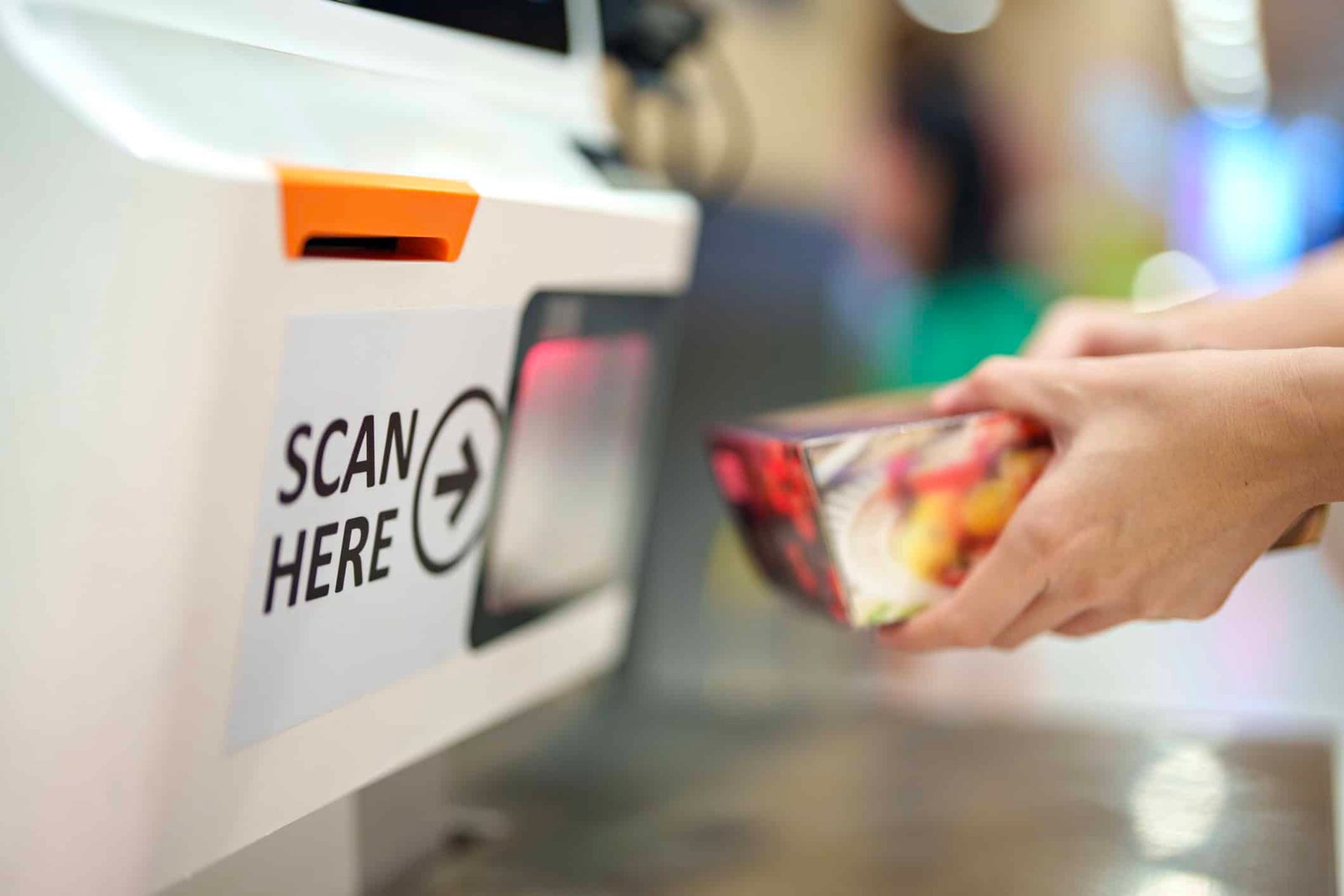
Cropped image of a woman's hands as she scans a grocery item at the self-checkout service in a grocery store.

October 31, 2024

iStock.com/Thai Liang Lim

Should Walmart’s Invisible Barcodes Become the Norm for Retail?

Share: LinkedInRedditXFacebookEmail

At Walmart’s self-checkouts, there’s no more scrambling to find the barcode on some items.

https://www.tiktok.com/@sushiissogoodomg/video/7408774397709864223

According to Retail Customer Experience, invisible barcodes — first introduced to Walmart in 2019 through a partnership with Digimarc — are specifically designed to streamline the checkout process for both employees and customers. These barcodes are printed all over an item and invisible to the naked eye. Previously, shoppers had to locate and align a visible barcode to scan an item, but this technology removes that step entirely.

“The scanning speed goes up significantly,” a spokesperson for Digimarc told the outlet. “Hunting for barcodes during the scanning process becomes unnecessary, which eases the self-scanning for customers.”

Now, as reported by The Mirror, Walmart is updating its self-checkout service by testing the invisible barcode technology on its Great Value branded items, though it could expand to more products if successful. Here are the key points:

  1. Invisible barcode implementation: The new barcodes are embedded across product packaging, allowing customers to scan items from any angle without searching for a visible barcode.
  2. Advanced scanning capability: Self-checkout machines are equipped with scanners that can detect multiple items simultaneously as customers pass products near the scanner.
  3. Customer convenience: This technology eliminates the hassle of misaligned or unrecognized barcodes, enhancing the shopping experience by simplifying the scanning process.
  4. Theft reduction: The system also aims to address rising theft at self-checkout lanes, making it more challenging for customers to skip scanning items. In 2022, U.S. retailers lost over $112 billion to theft, with Walmart facing $3 billion in annual losses at self-checkout kiosks.
  5. Investment and testing: Walmart is investing $3 million annually into this technology, which is currently being tested in select stores with promising initial results.
  6. Industry impact: If successful, this technology could lead to wider adoption among other retailers, as seen with similar initiatives by Wegmans.

Digimarc explained in a report that the rollout of Digimarc Barcodes on product packaging is unlikely to occur widely in the near future, as the traditional barcode remains integral to over 10 million products globally. Industry experts Erik Bank of Digimarc and Thomas Pahlings from Datalogic anticipate that initial implementations will focus on private-label items. This approach is feasible because retailers have control over their own packaging, unlike national brands that require a collective industry shift.

The Digimarc Barcode doesn’t require special inks or complex printing processes to embed the GTIN number. Instead, an algorithm adjusts the print data to create tiny dots that hold the information, readable only with image-based scanners and compatible software.

Interpack highlighted some drawbacks to invisible barcodes: Camera-based scanners involve high upfront costs, current global IT systems tied to conventional barcodes can’t be changed overnight, and critics question the reliability of error-free code reading. Additionally, labeling bulk items remains a challenge.

An interesting note from Daily Dot revealed that every few years, a video of someone discovering this feature goes viral, surprising customers unfamiliar with it. While employees may be informed, it seems the technology hasn’t been widely advertised to shoppers yet.

The question then remains: Is there a reason Walmart hasn’t widely promoted this Great Value feature in stores, on its website, or across social media? Highlighting it could encourage more customers to choose Great Value products for quicker self-checkout times, but it’s possible that Walmart is prioritizing the anti-theft benefits of invisible barcodes.

BrainTrust

"It is a good concept. However, the adoptions as the only barcode on the product will be slow for several reasons, most notably the cost of replacing scanner technology. "
Avatar of Perry Kramer

Perry Kramer

Managing Partner, Retail Consulting Partners


"Once you move consumer expectations and behavior toward leveraging this tech, then you will realize the productivity gains. Until then, benefits will be slow to be realized."
Avatar of Mark Self

Mark Self

President and CEO, Vector Textiles


"The concept is interesting. If Walmart’s first steps work well, I see no reason why it can’t expand throughout the industry."
Avatar of John Karolefski

John Karolefski

Editor-in-Chief, CPGmatters


Recent Discussions

Discussion Questions

How might invisible barcode technology change consumer expectations around convenience in retail, and what implications does this have for customer experience management?

What challenges could hinder the widespread adoption of invisible barcodes, particularly regarding resistance from national brands to change packaging?

Given the financial losses from theft, how can retailers balance the use of technology like invisible barcodes for loss prevention with maintaining a positive customer experience in self-service settings?

Poll

15 Comments
Oldest
Newest Most Voted
Inline Feedbacks
View all comments
Neil Saunders

This seems like a good idea for several reasons: it means no packaging space is taken up by a barcode box (not a massive issue, but modestly helpful for packaging designers), it makes scanning easier and faster, and it should prevent some self-checkout theft where people pretend to scan items by covering the barcode. My question is how challenging is it for packaging is to be redesigned to incorporate this new invisible barcode and how much cooperation will there be in making this a new standard. It’s easy for Walmart and Wegmans (which has also adopted the tech) to do this on their own private brands, but getting all national brands to adopt this standard might be difficult. I also think RFID seems like a better bet as it allows for the mass scanning of items, item tracking in store, and better inventory management.

Perry Kramer
Perry Kramer

It is a good concept. However, The adoptions as the only barcode on the product will be slow for several reasons most notably the cost of replacing scanner technology. However, this technology can be a home run when used in parallel with current bar code Symbologies. it can be an enabler of customer adoption with the continued growth of self checkout technology. Replacing the Scanner tech in SCO units is a much more affordable approach. The challenge with traditional scanners at checkout lanes have a 7 to 10 year life expectancy which is the a large hurdle.

Craig Sundstrom
Craig Sundstrom

I’m having trouble seeing how this works (pun semi-intended); by which I mean I understand the concept – I think – but there still seem like a number of unresolved issues: how do you override a “no scan” condition, or verify prices on the shelf?

Adam Dumey
Adam Dumey

This technology is fascinating; however, I am not convinced that the business merits warrant a new technology introduction and business process reengineering. Sure – faster scanning and potential theft reduction but, given existing flows and loss-prevention camera technology, will this drive overcome a $3M annual, per-store investment? A benefit of Walmart’s existing store size is the # of existing Walmart POS. This footprint (in my experience) drives minimal, to no, wait times even during the busiest periods. So the notion of faster scans, even from a customer experience fashion, doesn’t scream higher retention or increased basket size. That said, Walmart’s cautious evaluation approach is prudent (e.g. its private labels, limited number of stores, no excessive marketing push).

Shannon Flanagan
Shannon Flanagan

One of the most game-changing technologies in my career has been RFID, which can solve these problems, but for a variety of valid and stupid, reasons, it’s been too slow to be widely adopted. I echo Neil’s call-out – can this really become a required standard? Very unlikely. Also, I’m curious how this will/will not work with 2D barcodes, if/when they take off. I think there is only upside to the customer experience and not sure if there needs to be promotion of the capability.

David Biernbaum

This technology first attracted the attention of the grocery industry, and myself, during NRF 2014. I picked up immediately that packages can be printed with hundreds of barcodes without affecting the design.

There is no doubt that the advantages will outweigh the growing pains. Bar codes are not attractive and are quite intrusive against the design, scheme, colors, and text of the package. This is a tremendous “plus” since design is an essential part of CPG sales and merchandising.

It looks like invisible bar codes are on their way to becoming the norm, because otherwise, why not? It also helps tremendously that Walmart is on the leading edge. The industry will follow.

Wegman’s is also testing the innovation, at least for its private label brands, so I’m eager to see how that goes.
.

Melissa Minkow

This is a win and reduces one of the big points of friction with self-checkout for the customer that often slows them down.

Mark Self
Mark Self

Once you move consumer expectations and behavior toward truly leveraging this technology (it has to be ubiquitous and not just at WM) then you will realize the productivity gains.
Until then the benefits will be slow to be realized.

Lisa Goller
Lisa Goller

Invisible barcode technology will make the self-checkout experience easier, faster and hassle-free. Customers don’t have to guess which side of a product a barcode is on or worry about a barcode that doesn’t scan because a printed label is crumpled.

Starting with private labels is smart to test the new system with Walmart’s own brands for greater end-to-end control over the process. Beyond the high cost of mass adoption, challenges include the glacial pace of global standards’ evolution. Systemwide changes demand consensus among diverse stakeholder groups with different needs.

Richard Hernandez
Richard Hernandez
Reply to  Lisa Goller

Private label is great place to start. I would suspect that there will need to a re-calibration of the barcode symbologies, or an investment in new scanner tech by retailers, if older. I do like what HEB has done with barcodes. They have made them fun like shaping the codes like pigs (for pork rinds) or other things like bottles and stars . Still readable but not staid, plain looking barcodes.

Lisa Goller
Lisa Goller

It would be interesting to see what has changed to understand the full extent of this new system.

John Karolefski

The concept is interesting. If Walmart’s first steps work well, I see no reason why it can’t expand throughout the industry.

Verlin Youd
Verlin Youd

Yes, innovation at work! Barcodes are great, so why not make them better again as they were with 2D barcodes and QR codes? It would seem to have great value potential in terms of ease and quickness of scanning as well as better design aesthetics. I do have one question … what is the chance for multiple barcode reads of the same item? I am sure the scanning hardware and software technology have been optimized however, even a fairly rare occurrence of double scanning could spell distaster.

Shep Hyken

This is a win/win for Walmart and its customers. First, the theft deterrent capability intrigues me. If Walmart can eliminate shrinkage, that savings can potentially lead to lower prices. And then there is convenience. The convenience of not having to search for a barcode could shave a few seconds off the scanning of items. While that doesn’t seem like much, it speeds up the checkout process, allowing for more customers to get through the lines in a shorter amount of time. And then there could be licensing of the technology. Lots of good can come from this technology.

John Hennessy

I discovered this technology at a trade show and confess to being one of those amazed by the capability. You see nothing but product graphics on the label and the product scans! This improves scan times and rates for both cashiers and those using self-checkouts. The 2D scanners required to read the invisible barcodes are widely used as 2D scanner technology is required to read barcodes from cell phone screens. This has all the hallmarks of something we’ll take for granted shortly.

15 Comments
Oldest
Newest Most Voted
Inline Feedbacks
View all comments
Neil Saunders

This seems like a good idea for several reasons: it means no packaging space is taken up by a barcode box (not a massive issue, but modestly helpful for packaging designers), it makes scanning easier and faster, and it should prevent some self-checkout theft where people pretend to scan items by covering the barcode. My question is how challenging is it for packaging is to be redesigned to incorporate this new invisible barcode and how much cooperation will there be in making this a new standard. It’s easy for Walmart and Wegmans (which has also adopted the tech) to do this on their own private brands, but getting all national brands to adopt this standard might be difficult. I also think RFID seems like a better bet as it allows for the mass scanning of items, item tracking in store, and better inventory management.

Perry Kramer
Perry Kramer

It is a good concept. However, The adoptions as the only barcode on the product will be slow for several reasons most notably the cost of replacing scanner technology. However, this technology can be a home run when used in parallel with current bar code Symbologies. it can be an enabler of customer adoption with the continued growth of self checkout technology. Replacing the Scanner tech in SCO units is a much more affordable approach. The challenge with traditional scanners at checkout lanes have a 7 to 10 year life expectancy which is the a large hurdle.

Craig Sundstrom
Craig Sundstrom

I’m having trouble seeing how this works (pun semi-intended); by which I mean I understand the concept – I think – but there still seem like a number of unresolved issues: how do you override a “no scan” condition, or verify prices on the shelf?

Adam Dumey
Adam Dumey

This technology is fascinating; however, I am not convinced that the business merits warrant a new technology introduction and business process reengineering. Sure – faster scanning and potential theft reduction but, given existing flows and loss-prevention camera technology, will this drive overcome a $3M annual, per-store investment? A benefit of Walmart’s existing store size is the # of existing Walmart POS. This footprint (in my experience) drives minimal, to no, wait times even during the busiest periods. So the notion of faster scans, even from a customer experience fashion, doesn’t scream higher retention or increased basket size. That said, Walmart’s cautious evaluation approach is prudent (e.g. its private labels, limited number of stores, no excessive marketing push).

Shannon Flanagan
Shannon Flanagan

One of the most game-changing technologies in my career has been RFID, which can solve these problems, but for a variety of valid and stupid, reasons, it’s been too slow to be widely adopted. I echo Neil’s call-out – can this really become a required standard? Very unlikely. Also, I’m curious how this will/will not work with 2D barcodes, if/when they take off. I think there is only upside to the customer experience and not sure if there needs to be promotion of the capability.

David Biernbaum

This technology first attracted the attention of the grocery industry, and myself, during NRF 2014. I picked up immediately that packages can be printed with hundreds of barcodes without affecting the design.

There is no doubt that the advantages will outweigh the growing pains. Bar codes are not attractive and are quite intrusive against the design, scheme, colors, and text of the package. This is a tremendous “plus” since design is an essential part of CPG sales and merchandising.

It looks like invisible bar codes are on their way to becoming the norm, because otherwise, why not? It also helps tremendously that Walmart is on the leading edge. The industry will follow.

Wegman’s is also testing the innovation, at least for its private label brands, so I’m eager to see how that goes.
.

Melissa Minkow

This is a win and reduces one of the big points of friction with self-checkout for the customer that often slows them down.

Mark Self
Mark Self

Once you move consumer expectations and behavior toward truly leveraging this technology (it has to be ubiquitous and not just at WM) then you will realize the productivity gains.
Until then the benefits will be slow to be realized.

Lisa Goller
Lisa Goller

Invisible barcode technology will make the self-checkout experience easier, faster and hassle-free. Customers don’t have to guess which side of a product a barcode is on or worry about a barcode that doesn’t scan because a printed label is crumpled.

Starting with private labels is smart to test the new system with Walmart’s own brands for greater end-to-end control over the process. Beyond the high cost of mass adoption, challenges include the glacial pace of global standards’ evolution. Systemwide changes demand consensus among diverse stakeholder groups with different needs.

Richard Hernandez
Richard Hernandez
Reply to  Lisa Goller

Private label is great place to start. I would suspect that there will need to a re-calibration of the barcode symbologies, or an investment in new scanner tech by retailers, if older. I do like what HEB has done with barcodes. They have made them fun like shaping the codes like pigs (for pork rinds) or other things like bottles and stars . Still readable but not staid, plain looking barcodes.

Lisa Goller
Lisa Goller

It would be interesting to see what has changed to understand the full extent of this new system.

John Karolefski

The concept is interesting. If Walmart’s first steps work well, I see no reason why it can’t expand throughout the industry.

Verlin Youd
Verlin Youd

Yes, innovation at work! Barcodes are great, so why not make them better again as they were with 2D barcodes and QR codes? It would seem to have great value potential in terms of ease and quickness of scanning as well as better design aesthetics. I do have one question … what is the chance for multiple barcode reads of the same item? I am sure the scanning hardware and software technology have been optimized however, even a fairly rare occurrence of double scanning could spell distaster.

Shep Hyken

This is a win/win for Walmart and its customers. First, the theft deterrent capability intrigues me. If Walmart can eliminate shrinkage, that savings can potentially lead to lower prices. And then there is convenience. The convenience of not having to search for a barcode could shave a few seconds off the scanning of items. While that doesn’t seem like much, it speeds up the checkout process, allowing for more customers to get through the lines in a shorter amount of time. And then there could be licensing of the technology. Lots of good can come from this technology.

John Hennessy

I discovered this technology at a trade show and confess to being one of those amazed by the capability. You see nothing but product graphics on the label and the product scans! This improves scan times and rates for both cashiers and those using self-checkouts. The 2D scanners required to read the invisible barcodes are widely used as 2D scanner technology is required to read barcodes from cell phone screens. This has all the hallmarks of something we’ll take for granted shortly.

More Discussions