Photo: Starbucks
Chris Doerschlag
Through a special arrangement, what follows is a summary of an article from WayfinD, a quarterly e-magazine filled with insights, trends and predictions from the retail and foodservice experts at WD Partners.
In recent years, a veritable flood of patent applications has re-imaged the decades-old and staid format of the drive-thru lane.
Consider the recent patent application submitted by NCR Corp. proposing new techniques for mobile ordering: A consumer’s mobile device, detected while in a drive-thru queue or close to a POS terminal, could simply serve up an “interactive ordering interface on a consumer’s mobile device” with a link to mobile payments.
One submitted by a San Diego-based inventor imagines customers communicating orders via wireless beacons. In another, RFID tags would allow regular customers to pre-order items and store payment information at a brand’s web site. Making her order for a small chili and potato lunch order the night before, a Wendy’s lunch-time regular could pull into and out of the Wendy’s drive-thru without ever waiting in line.
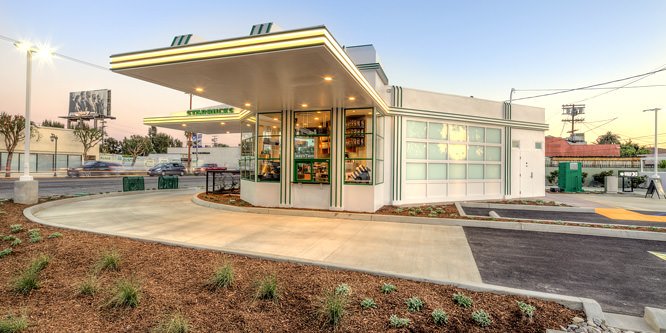
Yet with an understanding of the human element in the traditional drive-thru process, Starbucks is adding video screens to 2,400 of its drive-thru lanes in the U.S. “It’s about that customer-barista connection,” a Starbucks spokesperson told Bloomberg. Following more than two years of testing the concept in its home state of Washington, the move shows Starbucks understands that the drive-thru’s evolution is about more than simply doing things faster and more efficiently.
There’s always a delta between what is possible technologically and what consumers actually want.
The drive-thru — largely unchanged since it first transformed America’s dining habits and food culture over four decades ago — can account for anywhere between 50 percent to 70 percent of sales at a quick-service restaurant, according to a recent study. This is a $200 billion industry, according to statista.com. To keep those sales, it’s time for things to change. Fast might not be soon enough.