DISCUSSION
Will facial recognition tech make for happier customers at Walmart?
Written by George Anderson
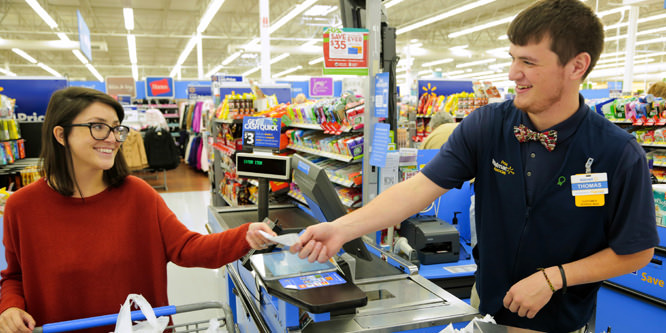
Photo: Walmart
A Walmart patent application filed in 2012 describes a system that would enable the chain to use facial recognition technology at the checkout. The purpose of the tech is to help store personnel determine if a customer is unhappy and, if they are, make contact to address any shopping-related problems
Mention of the technology was included in a Wall Street Journal article on the increased use of automation to replace or augment human activities in stores. The same piece referenced a 2015 Citi Research report that found two-thirds of the retail jobs in the U.S. are at “high risk” of being eliminated by 2030.
Walmart’s patent application abstract describes the goal of using facial recognition technology to improve customer service, not just in the moment, but longer term. “The biometric data of a customer may be correlated to transaction data of the customer in order to detect changes of the purchase habits of the customer due to dissatisfaction. Changes in purchase habits, such as loss of a customer, may be used in combination with the biometric data to establish thresholds of biometric data use to generate customer service actions.”
In the end, Walmart is hoping the technology, if deployed, will enable it to hold onto existing customers, since doing so is much less expensive than acquiring new ones. Management also envisions the technology as a tool it can use to cut staffing costs. In its application, Walmart acknowledges that it can “be very expensive to maintain sufficient staff to provide great customer service. It can also be difficult to establish an appropriate staffing level that will provide proper customer service without excess staffing.”
The use of facial recognition is controversial because of privacy concerns. The technology is being used to reduce shoplifting by some retailers. In some cases, stores catching shoplifters have given them the choice of having their faces scanned or being prosecuted. Images of those scanned go into a database that alerts security personnel when they enter a store. Authorized staff can then tell the shoplifter that they have been banned from the location.